
Start with the work, not the brand
Write down three jobs you want to do before making a shortlist. Hanging hardware, assembling furniture, and making holes call for a different buying conversation from choosing a tool mainly for repeated fastening. Our starting recommendation for a mixed drilling-and-screwdriving workload is to research a drill/driver first. That is an editorial judgement about versatility, not a measured test result.
If fastening dominates your plans, read our drill versus impact driver guide. A tool called a drill/driver should not be confused with a hammer drill; the DCD794/DCD799 manual treats the hammer function as model-specific.
Match the tool to your battery system
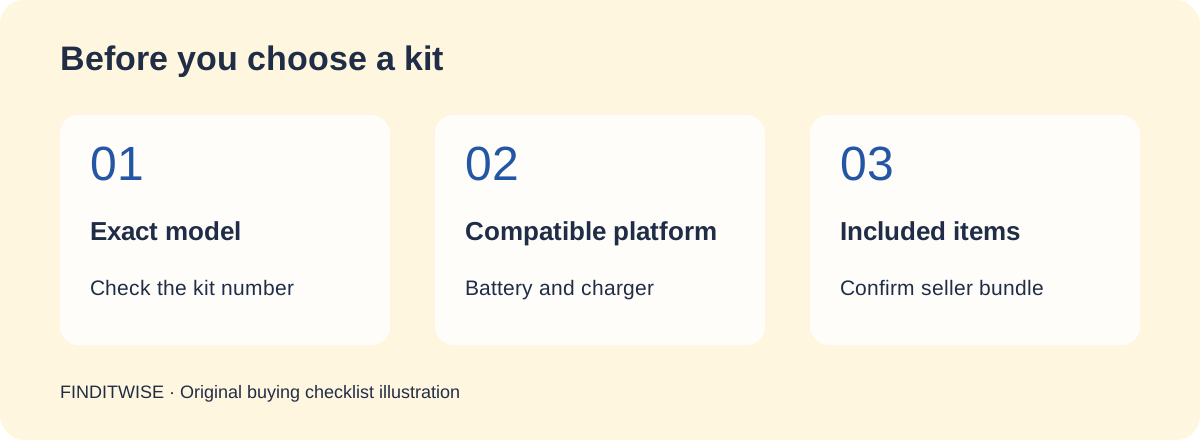
Record the exact battery model and charger you own. Then check the shortlisted tool’s compatibility documentation. Neither a shared brand nor a similar voltage label establishes compatibility. Milwaukee’s 3403-22 kit is an M12 product; do not treat an existing M18 battery collection as evidence that it will fit.
For a first tool, research the platform as a future expense: which other tools would you realistically add, and which batteries and chargers would each need? Do not pay for hypothetical expansion that you are unlikely to use. Our 18V versus 20V explanation helps separate voltage labels from compatibility.
Check chuck, modes, and controls
The chuck determines which bit shanks the tool can accept. Both drill kits in our shortlist are manufacturer-listed with a half-inch chuck. That specification alone does not establish drilling capacity in a material or the tool’s real-world grip.
Look for model-specific operating instructions rather than assuming every numbered collar means the same thing. The DeWalt manual describes an adjustable screwdriving clutch and explains that the drilling position bypasses it. For your own tool, use its exact manual to identify the control behaviour.
Compare the complete purchase
A bare-tool listing and a kit are different purchases even when they contain the same drill. Write down the included battery count, battery models, charger, and accessories. Compare what you must add before the tool is usable. A lower tool-only price is not necessarily a lower first-tool cost.
The manufacturer bundle is the reference point, but the retailer’s exact listing still needs checking. Read kit versus bare tool before comparing offers across US and Canadian marketplaces.
Use this shortlist checklist
- Name the jobs and materials you intend to work on.
- Confirm exact battery and charger compatibility.
- Check the operating modes in the model’s manual.
- Record every included item and every extra purchase.
- Compare like-for-like dimensions and weights; check whether a battery is included in those figures.
- Recheck the exact retailer model and bundle before purchasing.
We have not measured drilling speed, run time, noise, durability, or ergonomics. Manufacturer specifications narrow a shortlist; they do not replace those measurements. If you can handle a display tool locally, assess grip and balance with an appropriate battery attached.
Where to go next
See our compact drill shortlist and DeWalt DCD794D1 versus Milwaukee 3403-22 for a concrete comparison.
Common questions
Were these tools physically tested by FindItWise?
No. This guide uses manufacturer documentation and explicitly identified editorial interpretation. It does not report hands-on test results.
Sources & references
- DEWALT DCD794D1 product specifications and kit contents — accessed October 3, 2026
- DEWALT DCD794/DCD799 instruction manual (mode selection and screwdriving) — accessed October 3, 2026
- Milwaukee 3403-22 manufacturer specifications and kit contents — accessed October 3, 2026
- DEWALT explanation of impact-driver rotational action — accessed October 3, 2026